Best new music: the evolution of curation from radio to AI
The first chord of a new track no longer has to fight its way through a radio programmer’s office before it reaches a listener.
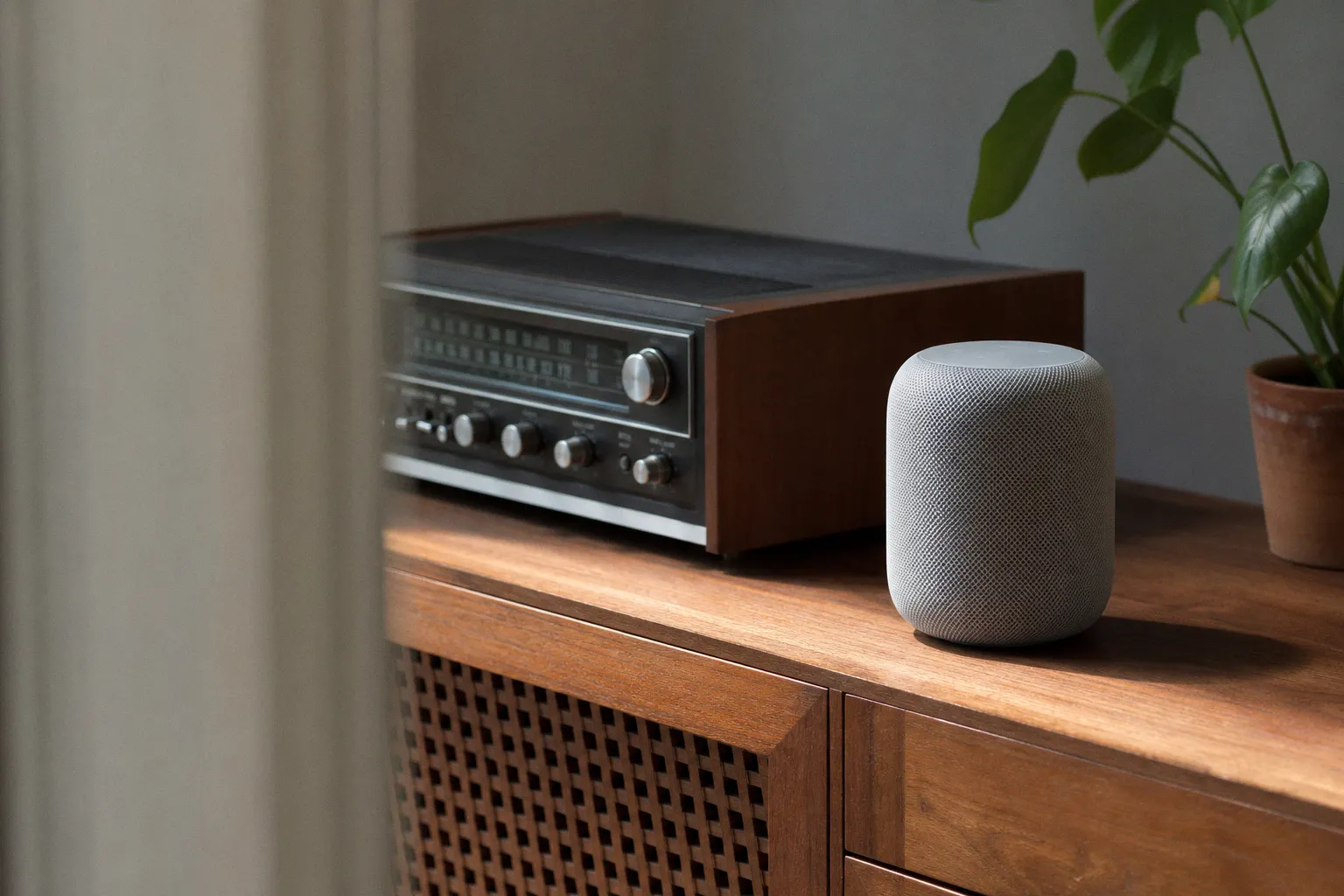
It can land in a Friday playlist, surface after a late-night search, or arrive inside a prompt-generated mix built around “bass-heavy pop for a night drive.” The route is faster. The control room is bigger. And nobody should confuse that speed with a single, settled answer to what “best new music” means.
That phrase once pointed listeners toward a relatively narrow set of outlets: radio rotation, record-store staff picks, music press, and the weekly charts. Today it can mean a Billboard placement, an editor’s selection, a Release Radar alert, a viral video soundtrack, or a recommendation engine reading the patterns in someone’s skips and repeats. The gates did not disappear. They multiplied, then learned to move.
The new gatekeeper does not simply pick a song. It decides which listener hears that song first.
From broadcast regulation to an always-on feed
Radio was never a neutral pipeline. In the broadcast era, a song’s path to mass exposure ran through a small number of stations, program directors, DJs, labels, promoters, and retail channels. A record with the right backing could hit a huge audience at once; a record outside that system could remain invisible no matter how sharp its hook or how ferocious its vocal performance.
That concentration helped create the payola scandals that reshaped US broadcasting policy. The Communications Act Amendments of 1960 became law on September 13 that year, requiring disclosure of payments connected to the broadcasting of material. The point was straightforward: listeners deserved to know when programming decisions had been bought.
The regulation did not turn radio into a frictionless meritocracy. No music system has managed that trick. But it established a central tension that still crackles through new music curation: who gets to decide what arrives in the listener’s ears, and what incentives sit behind the decision?
For decades, radio’s answer was legible. A station had a format. Its music director worked a rotation. The heavy songs arrived repeatedly, often at specific hours, until familiarity hardened into demand. The audience could feel the machinery. You heard the same chorus again at the grocery store, then in the car, then blasting out of a bar doorway. Repetition was not an accident; it was crowd control.
Streaming changed the physical impact of that model. Instead of one station serving a metropolitan audience, platforms could build a different lane for every listener. The shared moment did not vanish, but it stopped being the only prize. A new single might dominate a global chart while another, smaller release becomes the defining track in a listener’s private week.
That is why asking for the best new tracks now requires a second question: best by whose meter? The loudest commercial arrival? The most adventurous editorial pick? The song that best matches an existing listening habit? Or the one that cuts through that habit and resets it?
Modern charts still carry the radio signal
It is tempting to frame the streaming era as a clean overthrow of radio. The data says otherwise.
Billboard’s Hot 100 remains a hybrid chart. Its rankings combine streaming activity, radio-airplay audience impressions, and sales data. That blend matters because it prevents the chart from becoming a pure readout of one platform’s behavior. A song can be everywhere in short-form video and still lack the sustained radio presence that turns a moment into broad, durable exposure. Conversely, a radio-supported record can keep its momentum even after the first streaming rush cools.
The result is neither old-fashioned nor fully algorithmic. It is a composite picture of different forms of attention.
| Discovery route | What it measures or prioritizes | What it can miss |
|---|---|---|
| Radio rotation | Format fit, repeat appeal, broad audience reach | Niche scenes, listener-specific taste, tracks that need time to unfold |
| Major charts | A combined picture of streams, sales, and radio exposure | Why listeners connect with a song in the first place |
| Editorial playlists | Human selection, sequencing, scene awareness, narrative | The full range of audience behavior outside the playlist’s frame |
| Personalized feeds | Individual listening patterns and likely affinity | Surprise, context, and music beyond the listener’s existing habits |
| Prompt-based AI mixes | A listener’s stated mood, setting, or sonic request | Reliable interpretation of taste, culture, or artistic significance |
There is a practical difference between a chart and a discovery tool. Charts look outward. They tell everyone in a country or market what is drawing measurable attention. Personalized systems look inward. They try to determine what you may play next.
YouTube makes that divide especially clear. Its Daily Top Music Videos chart refreshes daily, while its Trending chart updates several times a day. Those lists are not personalized: viewers in the same country see the same chart. But the recommendation layer that pushes videos into individual feeds works differently, drawing on signals including viewing history, searches, subscriptions, reactions, and satisfaction indicators.
That distinction matters for artists, too. A chart placement is a public signal. A recommendation is often a private one. A musician can be winning thousands of intimate algorithmic auditions every day without yet appearing as a conventional mainstream event.
Discover Weekly changed the tempo of new releases
Spotify’s Discover Weekly, launched in 2015, gave listeners a ritual: a fresh 30-track playlist every Monday. It made discovery feel less like digging through bins and more like opening a message addressed to one person.
Its genius was not merely personalization. It was timing. Monday had traditionally been a low-voltage day in the release cycle, especially after the industry’s global release date consolidated around Friday. Discover Weekly created a second weekly pulse. Friday supplied the flood. Monday offered a handrail through it.
Spotify reported in June 2025 that Discover Weekly had passed 100 billion streams. The company also said the playlist was generating more than 56 million new artist discoveries per week, with 77% of those discoveries involving emerging artists. Those are platform-reported figures, not audited measures of the entire music business, and they do not prove that every discovery becomes a lasting fan relationship. Still, they show the scale of the mechanism. This is no longer a niche feature humming quietly in the corner of an app.
Release Radar, launched in 2016, attacks the same problem from a different angle. It updates on Fridays and prioritizes new music from artists a listener follows, alongside artists the service expects they may enjoy. If Discover Weekly is the crate-digger friend who slips in a left-field cut, Release Radar is the release-day alert system: familiar names, fresh drops, immediate access.
The two products reveal how music discovery algorithms split listening into distinct moods:
1. Affinity discovery works from what a listener already plays. It tries to extend a line: if this vocalist, drum texture, or songwriting shape works, here is another record in the same sonic weather.
2. Release monitoring reduces friction around artists a listener has already chosen. It solves the simple but real problem of missing an official single premiere or an album release date in an overcrowded week.
3. Editorial discovery interrupts the loop with a human point of view. A playlist editor can place a new artist beside an established one because the transition creates a spark, not because the two acts share a statistically convenient cluster.
4. Chart discovery supplies the common reference point. It is where listeners encounter the record that has become too large to ignore, whether they love it or not.
The strongest discovery routine uses all four. Rely only on affinity and a listener can end up in a beautifully tuned echo chamber: every snare hits at the expected weight, every chorus resolves on schedule, nothing genuinely surprises. Rely only on charts and the listening day becomes an exercise in catching up with everyone else.
A recommendation engine can match a mood. It cannot guarantee a jolt.
The AI frontier: ask for a feeling, get a queue
The next shift is not just more personalization. It is conversational personalization.
Spotify expanded the beta of its AI Playlist feature to Premium users in more than 40 additional markets in April 2025, including the United States. The premise is simple: type a natural-language request, receive a personalized playlist, then refine it. “More upbeat.” “Less electronic.” “Keep the late-night tension, but add bigger choruses.” The user is no longer choosing from a fixed shelf of genres and moods. They are directing the set.
YouTube Music’s Ask Music works in a similar territory. A listener can ask for a type of mix, and the system uses a large language model to produce a custom mix title and a brief explanation. Google also makes the limitation plain: quality and accuracy may vary. That caveat should be read in bold, even when the interface is sleek.
AI can be impressively useful at translating a vague situation into playable music. “Tracks for the walk home after a loud show.” “New R&B with low-lit production and no ballads.” “Aggressive rap for a gym session, but not explicit.” Those are not traditional genre tags. They are emotional and practical instructions. For listeners, that is a real upgrade in control.
But an AI-generated label is not criticism, and a generated playlist is not an artistic verdict. Language models are built to make prompts feel understood. That is not the same as understanding the cultural voltage of a release, the significance of a new collaboration, or the difference between a genuinely raw vocal take and a performance merely dressed to sound raw.
The risk is subtle. Old gatekeepers were visible enough to argue with. A radio format could be named. A magazine critic signed their review. An editorial playlist carried a recognizable brand. AI curation can feel like pure listener agency while still depending on opaque systems: catalog access, licensing, training choices, product design, recommendation priorities, and the data a platform decides to value.
YouTube says its recommendation system learns from more than 80 billion signals every day. The number conveys scale, not taste. A vast signal field can identify patterns in behavior; it cannot settle whether a record matters beyond those patterns.
This is the pressure point for artists releasing music now. The opening seconds of a track may need to grip quickly because skips are measurable. The song title, artwork, release timing, visual assets, and early fan response all feed the momentum around an official drop. Yet making music solely to satisfy a feed can flatten the very identity that gives an artist a future beyond one cycle.
A track should not have to sound like a trailer for itself.
Human editors still set the room
For all the talk of replacement, human curation remains embedded in the streaming era. Spotify identifies New Music Friday and Fresh Finds as playlists curated by its global editorial team. That is not a decorative legacy feature. It is a different kind of listening proposition.
An editor can hear a release as part of a wider movement. They can spot the production choice that links an emerging singer to a scene forming three cities away. They can sequence a playlist with tension and release: strip the arrangement down, bring in the bass-heavy record, then let a ballad clear the air. Data can register that listeners move from one track to another. A skilled editor can make the transition feel inevitable.
This is particularly important for new artists. Algorithms often work best when there is already a signal to read: streams, saves, follows, repeat plays, adjacent listening behavior. But the artist at the beginning of a release cycle may have almost none of that. Human editors, DJs, journalists, and trusted local curators can take a risk before the numbers begin to hum.
That does not make human curation automatically fairer. Editors have their own tastes, blind spots, commercial pressures, and institutional habits. The difference is that their choices can be examined as choices. A listener can disagree with an editor’s taste, trace a playlist’s sensibility, and seek a competing voice.
The healthiest new music curation does not pretend one system has solved the problem. It lets the systems challenge each other. Use the chart to understand scale. Use editorial playlists to hear a point of view. Use Release Radar to keep up with artists already in your rotation. Use Discover Weekly to widen the frame. Use AI prompts when you know the feeling you want but not the artist who can deliver it.
Then step outside the feed occasionally. Search a label roster. Watch a new music video from an unfamiliar director. Follow the credits on a track whose mix hits with unusual force. The deeper discovery often begins there, after the autoplay has done its work.
The verdict: curation is now a live mix, not a verdict
The best new music is no longer delivered by one voice with the power to declare a winner. It arrives through competing systems: radio’s remaining reach, charts’ public scoreboard, editors’ taste, algorithms’ prediction, and AI’s growing ability to respond to a request in plain language.
That is messier than the old hierarchy. It is also more alive.
For listeners, the winning move is not to choose a side between human instinct and machine sorting. It is to listen across the seams. Let the algorithm bring the first draft. Let the editor complicate it. Let the chart reveal the scale of the moment. And when a new track hits hard enough to stop the scroll—when the beat locks, the vocal lands, and the whole room in your headphones suddenly feels charged—trust that reaction before any playlist explains it.