Osheaga Music Festival Lineup: Why This Curation Matters
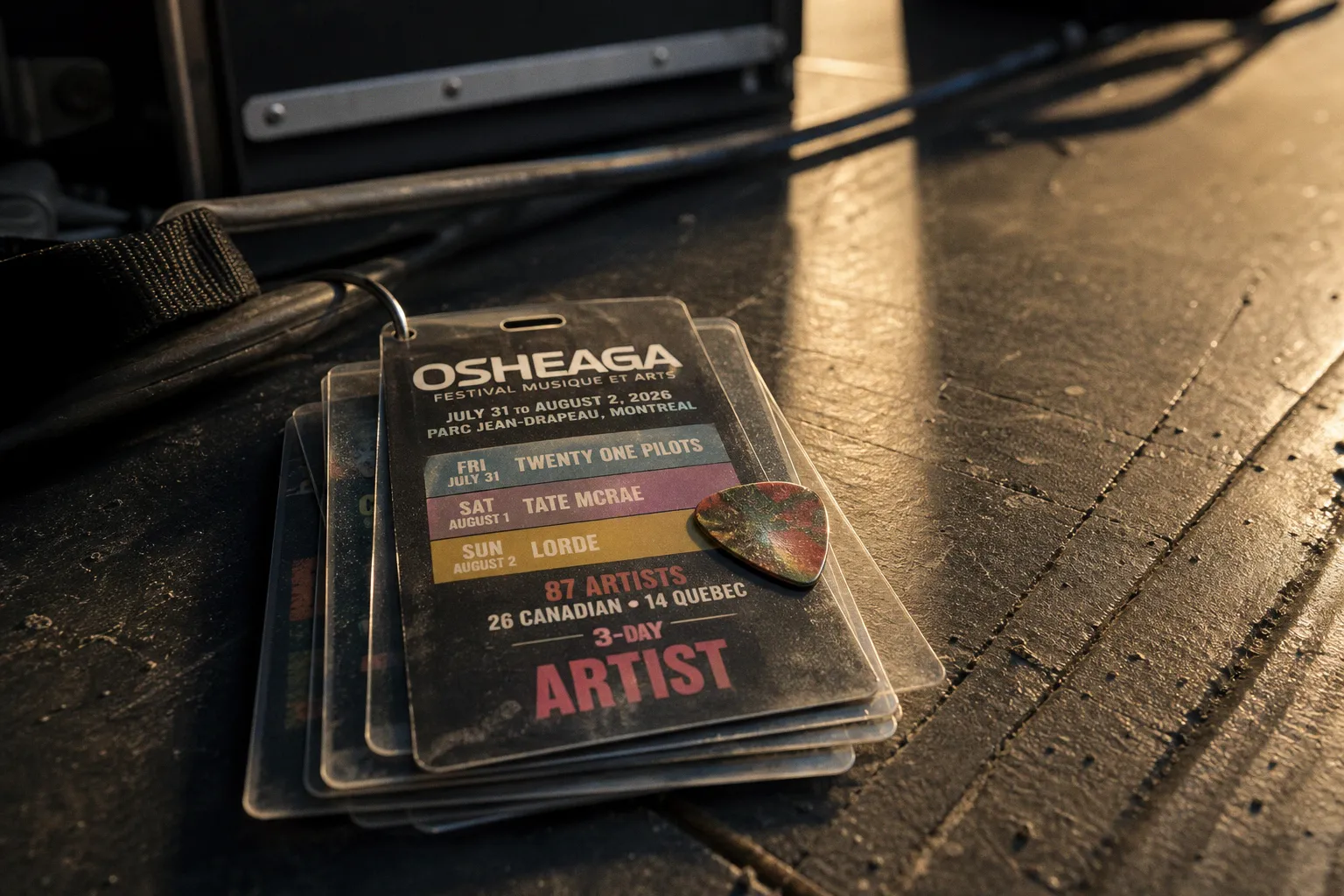
Eighty-seven artists across six stages, three days, and one Quebec island. That is the raw arithmetic of Osheaga 2026, the 19th edition of the Montreal booking exercise, scheduled for July 31 through August 2 at Parc Jean-Drapeau.
Osheaga Music Festival Lineup: Why This Curation Matters
On paper the lineup reads less like a festival poster and more like a portfolio: a deliberate distribution of legacy acts, domestic talent, and streaming-era momentum spread across the Bell River, Coors Light Mountain, belairdirect Valley, Scotia Forest, Coca-Cola Island, and SiriusXM Backyard Sessions stages. The headline names — Twenty One Pilots, Tate McRae, and Lorde — anchor the bill, but the metrics underneath that announcement tell the more instructive story about where North American festival curation is moving in the post-pandemic booking cycle.
Three headliners, six stages, 87 acts, 26 of them Canadian. Osheaga 2026 is positioning itself as a market index, not just a concert.
The 2026 Headlining Trio: Balancing Legacy and Momentum
The top-of-bill distribution follows a familiar three-pronged risk model. Friday belongs to Twenty One Pilots, returning to Osheaga for the first time since 2015. Saturday is claimed by Tate McRae, the Calgary-born pop artist making her Osheaga debut — and, per the festival's billing, her only Canadian festival appearance of 2026. Sunday closes with Lorde, in her third Osheaga appearance after sets in 2014 and 2017. Each slot is engineered to convert a different audience segment into a ticket sale.
| Headliner | 2026 Slot | Prior Osheaga Appearances | Strategic Function |
|---|---|---|---|
| Twenty One Pilots | Friday, July 31 | 2015 (return engagement) | Legacy reunion play; established catalog and festival reliability |
| Tate McRae | Saturday, August 1 | None — debut | Streaming-era pull; exclusively Canadian festival date in 2026 |
| Lorde | Sunday, August 2 | 2014, 2017 (third appearance) | Prestige closer; long-cycle artist with high per-stream conversion |
Three different commercial logics, three different audience retention curves. Twenty One Pilots deliver a tested festival metric — the band has logged reliable multi-year touring revenue and a stable algorithmic footprint. Lorde's third booking functions as a prestige asset: she is the kind of artist that lifts the festival's perceived cultural weight in a competitive North American summer market. Tate McRae is the growth bet. Her sole-Canadian-festival-of-the-year designation is not a footnote — it is a booking lever. Festival promoters price scarcity, and a headliner with a single domestic date in a calendar year commands premium secondary-market activity in the surrounding region.
Genre Diversity and the Six-Stage Experience
The 2026 edition distributes its 87-artist roster across six branded stages, each with a curated genre remit. The headliner-tier Bell River Stage also hosts The Neighbourhood and Mt. Joy. The Coors Light Mountain Stage is the festival's rock-adjacent and hip-hop crossover zone — Kehlani, The xx, and Gunna all slot in there. The belairdirect Valley Stage is heavier in profile: JID and Turnstile share a bill aimed at alternative and hardcore-leaning audiences. The Scotia Forest Stage tilts toward indie and post-punk, with Geese and Franz Ferdinand booked into the same architectural space. The Coca-Cola Island Stage is the electronic pipeline — Amélie Lens and VTSS represent the harder techno wing of the 2026 program. The SiriusXM Backyard Sessions stage is reserved for local Canadian talent, functioning as the festival's discovery tier.
This is not accidental segmentation. Festival operators have learned that stage design drives dwell time, and dwell time drives on-site revenue. The genre split also hedges against single-demographic weather risk; a pop-leaning Saturday can be insulated by an electronic-leaning Sunday, and vice versa. Six stages, three days, 87 acts — that works out to an average of roughly 4.8 acts per stage per day, with overlap engineered to prevent bottlenecks at any single platform.
Six stages is not a logistical detail. It is a revenue architecture — engineered to maximize ticket-holder dwell time and on-site concession capture.
The genre spread is broad but not unfocused. Pop (Tate McRae, Kehlani), alternative rock (The Neighbourhood, Mt. Joy, The xx), hip-hop (Gunna, JID), electronic (Amélie Lens, VTSS), and post-punk revival (Franz Ferdinand, Geese) all have anchor slots. The lineup reads as a triangulated booking strategy: enough legacy acts to satisfy the festival's older subscriber base, enough new-gen streaming artists to capture the under-30 demographic, and enough underground credibility on the electronic and indie stages to retain the music-press audience that drives festival reputation.
Championing Canadian Talent: From Local Roots to Global Stages
Of the 87 artists on the 2026 bill, 26 are Canadian — a 30% domestic share that outpaces the typical North American major-festival ratio. Fourteen of those 26 are homegrown Quebec artists, including Wolf Parade, Mother Mother, Bob Moses, and Super Plage. That is not a token allocation; it is a structural commitment.
| Tier | Canadian Share | Notable Quebec Acts |
|---|---|---|
| Headliners | 1 of 3 (Tate McRae, Calgary) | — |
| Mid-bill (Coors Light Mountain, belairdirect Valley) | Multiple slots | Wolf Parade, Bob Moses |
| Discovery tier (SiriusXM Backyard Sessions) | Stage-dedicated | Super Plage, additional local talent |
| Cross-stage total | 26 of 87 artists | 14 Quebec acts |
The commercial rationale is straightforward. Domestic acts reduce touring cost exposure — they are already on the continent, often within driving distance of Montreal, and they minimize the artist-travel line item that has squeezed festival margins since 2022. They also generate local media coverage that international headliners cannot, and they provide a reliable base of audience that purchases multi-day passes rather than single-day tickets tied to a specific headliner. For Quebec-based acts specifically, Osheaga functions as a domestic showcase that can lift an artist's streaming metrics inside the province within a single festival cycle.
The international acts fill the slots that Canadian headliners cannot. Lorde and Twenty One Pilots draw cross-border U.S. attendance into Montreal, which has downstream effects on hotel occupancy, restaurant revenue, and the Quebec tourism board's summer marketing metrics. The headliner trio is engineered to be commercially self-funding through ticket and travel-package revenue, while the domestic acts absorb the mid-bill cost without diluting the festival's brand premium.
Beyond the Headliners: The evenko Foundation and Community Impact
Embedded in the 2026 ticketing structure is a charitable mechanism: for every ticket sold, $1 is donated to the evenko foundation, which supports the provision of musical instruments to schools in need across Quebec. At a 2026 attendance scale comparable to recent Osheaga editions — the festival has historically drawn daily crowds in the high five figures — the per-ticket dollar translates into a five-figure donation floor before any sponsorship top-ups.
The $1-per-ticket mechanism is a low-friction CSR line item that produces measurable provincial impact without raising the public ticket price.
This is a structural feature, not marketing decoration. Festival operators have increasingly used per-ticket charitable commitments as a defensive PR instrument — a hedge against local-government scrutiny, noise complaints, and the political pressure that large-scale outdoor events face in dense urban markets like Montreal. The Quebec school-instrument program is a defensible beneficiary because it ties the festival directly to the province's education budget conversation. It also generates press coverage that an equivalent cash sponsorship would not: local education reporters will cover this in a way they would not cover a standard corporate activation.
The community-impact angle is one piece of a broader festival positioning strategy. Osheaga is no longer competing only with other Canadian festivals — it is competing with the North American summer festival circuit, where Coachella, Bonnaroo, Lollapalooza, and Austin City Limits all run overlapping booking windows. Differentiation in that market depends less on headliner prestige (which is roughly commodified across the major festivals) and more on localized value propositions. The Quebec school-instrument commitment, the 26-artist Canadian share, and the dedicated SiriusXM Backyard Sessions stage for local talent are all elements of that differentiation strategy. They are defensible, repeatable, and they reinforce the festival's positioning as Quebec's flagship summer music event rather than just another North American multi-stage production.
The Curation Logic in Context
Read together, the 2026 numbers describe a festival that has internalized the post-pandemic booking environment. Eighty-seven artists is a deliberate scale — large enough to justify the multi-day ticket price, small enough to keep curation coherent across six stages. Three headliners covering legacy, momentum, and prestige minimizes single-booking risk. Twenty-six Canadian acts (with fourteen from Quebec) anchor the local market. The six-stage split hedges genre and weather exposure. The $1-per-ticket charitable mechanism produces measurable community impact and PR defensibility at negligible cost. There is little here that reads as improvisation.
The test of the 2026 curation will not come from the headliner performances themselves. It will come from the secondary metrics: secondary-market ticket pricing on Saturday (the Tate McRae-only-Canadian-date play), Saturday-to-Sunday retention rates, on-site concession capture per attendee, and the streaming lift for the discovery-tier SiriusXM Backyard Sessions artists in the 30-day window after the festival closes. Those are the numbers that will determine whether the 19th edition's curation model gets replicated in 2027 — or revised. For an industry that has learned to treat festival lineups as portfolio construction, Osheaga 2026 is, at minimum, a coherent and defensible index allocation.
For broader coverage of how major live music events are reshaping regional economies, the reporting at The Nice News tracks related developments across the touring and live sector.